
Jungle Volcano RTP, the lowest price, the hardest ride
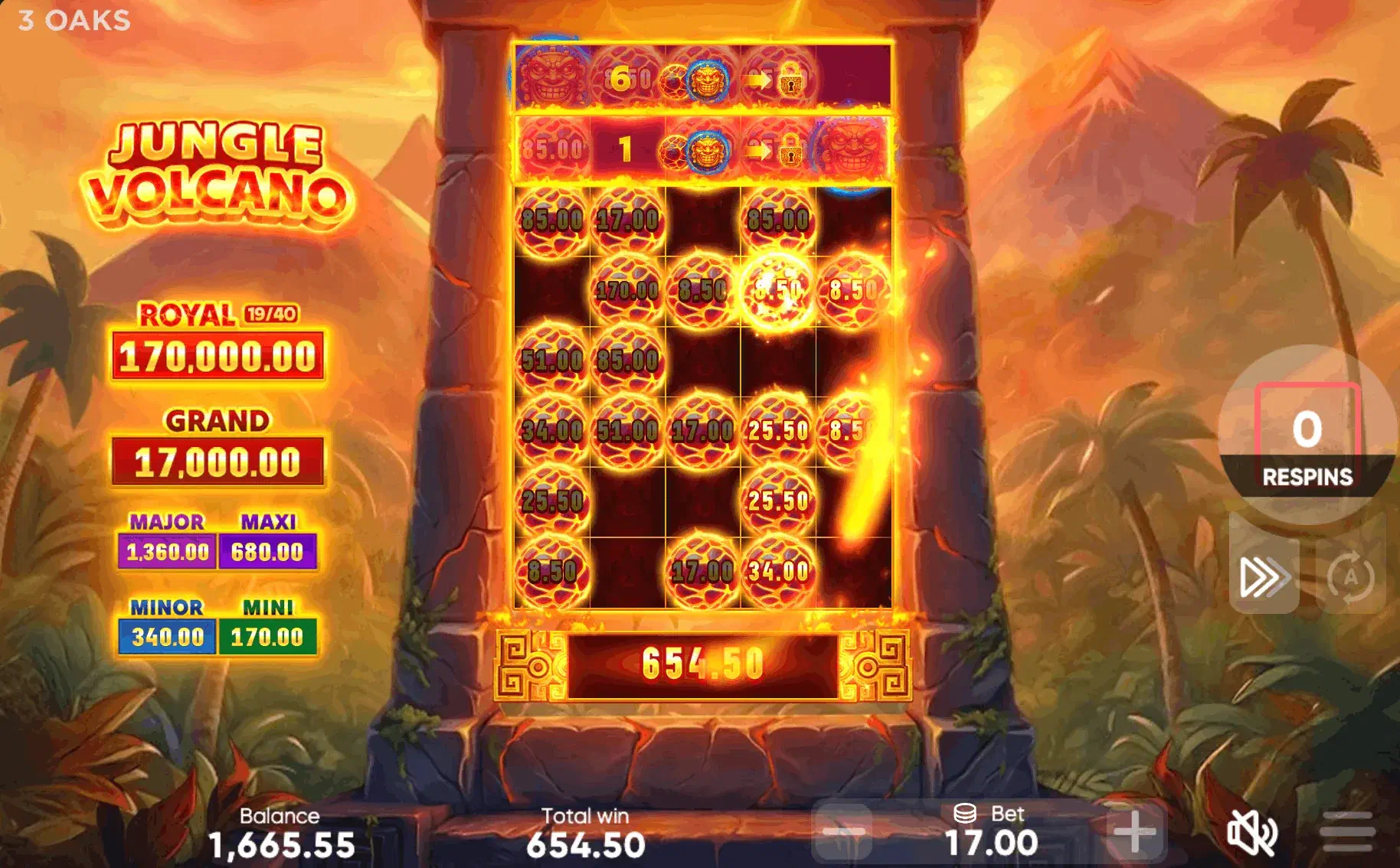
Jungle Volcano charges less per unit staked than any other slot in this lineup, and it is the one most likely to empty a bankroll before lunch. Those two statements are not in tension; they describe different things. The percentage is a price, the variance is an experience, and confusing the two is how players end up surprised by a game whose numbers they had already read.
The math, in dollars
The published return is 95.80%. Turn it around and you have the casino’s share: a house edge of 4.20%, the lowest in the 3 Oaks volcano family, and enough to make this the cheapest of the seven per dollar wagered.
Give it a stake. A thousand spins at $0.20 puts $200 through the game, and the theoretical long-run cost of that $200 is roughly $8.40. Compare it with the family baseline of about $8.68 and you have the honest size of the advantage: 28 cents across a thousand spins. It is real, it is measurable, and it is dwarfed by everything in the next section. Both figures are averages taken over sample sizes no player will ever produce, not forecasts for your session.
Why your session ignores the average
A published return converges over hundreds of thousands of spins. A thousand is statistically nothing, and on this title it is less than nothing, because Jungle Volcano carries a volatility rating of High, the most demanding profile among the volcano slots by a wide margin.
Unlike the Coin Volcano family, this game does pay outside its headline feature. Base symbols win, the mini bonus threads smaller payoffs between the big events, and power symbols land in ordinary spins. So the return is genuinely spread across three layers rather than locked behind a single trigger. What high volatility does is decide the proportions, and the proportions are lopsided, the free-spins round, with rows unlocking as it runs, carries the bulk of the percentage. Base wins and the mini bonus keep a session moving; the free spins are where the money is. The practical consequence is that a hundred spins without the feature is not a malfunction or a cold machine, it is the shape of the distribution, and the published figure assumes you keep spinning long past the point most people stop.
Check the paytable in your own lobby
Operators install certified configurations, not abstractions, and the same slot can ship in more than one. This title is quoted consistently across sources, which is a good sign rather than a guarantee, the only document describing your installation is the in-game info panel.
Open it before you set a stake. It gives you the return for your version, the bet range the operator allows, and the jackpot value, all of which are worth confirming on a game whose ceiling does so much work in the marketing. In a US-licensed lobby the state regulator’s certification fixes which build is running, the Pennsylvania Gaming Control Board, the Rhode Island Lottery, the Maine Gambling Control Unit or whichever agency licenses your operator signs off on it, and the operator cannot substitute a different configuration without going back through that approval. On an offshore site nobody holds that role, and the paytable is whatever the site chooses to display.
The full 3 Oaks volcano lineup
| Slot | Return to player | Cost per $100 wagered | Why it matters |
|---|---|---|---|
| Coin UP Volcano | see your casino's paytable | read from your panel | Newest release: expanding board and a per-line jackpot ladder |
| Coin Volcano | 95.66% | $4.34 | The gentler alternative, a smaller board where the whole return sits behind one feature |
| Coin Volcano 2 | 95.66% | $4.34 | Multiplier cells and a modest ceiling, at the family’s standard price |
| 3 Coin Volcanoes | 95.67% | $4.33 | Longer bonus rounds and a steadier rhythm than anything on this page |
| 3 Super Coin Volcanoes | 94-96% | $4.00-$6.00 | The one title whose price depends on your casino rather than the studio |
| Jungle Volcano (this page) | 95.80% | $4.20 | The cheapest slot in the group, and the only one with genuine free spins carrying the load |
| Lava Coins Hold and Win | 94.63% | $5.37 | The costliest title here, and a reminder that low variance is not the same as good value |
| Lava Coins 2 | 95.50% | $4.50 | A collector loop priced above the core series but below its predecessor |
The middle column translates the return into money, which is the only form in which two slots can be honestly compared. It also shows how narrow the differences are, and why variance, not price, should drive the choice on this particular game.
- Jungle Volcano fact sheet : symbols, free spins, design
- Finding it at a casino : what to verify before depositing
- Free demo , the cheapest possible audition for this variance
Every figure above is a theoretical long-run average and predicts nothing about a session. Real-money play is for players 21 and over through operators licensed in the eight iGaming states; 1-800-GAMBLER is free, confidential and always open.