
Coin Volcano RTP, the number, and what it costs you
Most pages that answer “Coin Volcano RTP” print a percentage and stop, which leaves you with a figure and no idea what to do with it. A return is only useful once you turn it around: what the casino keeps, what that costs at the stake you actually play, and whether the version in front of you is the one the number describes.
The math, in dollars
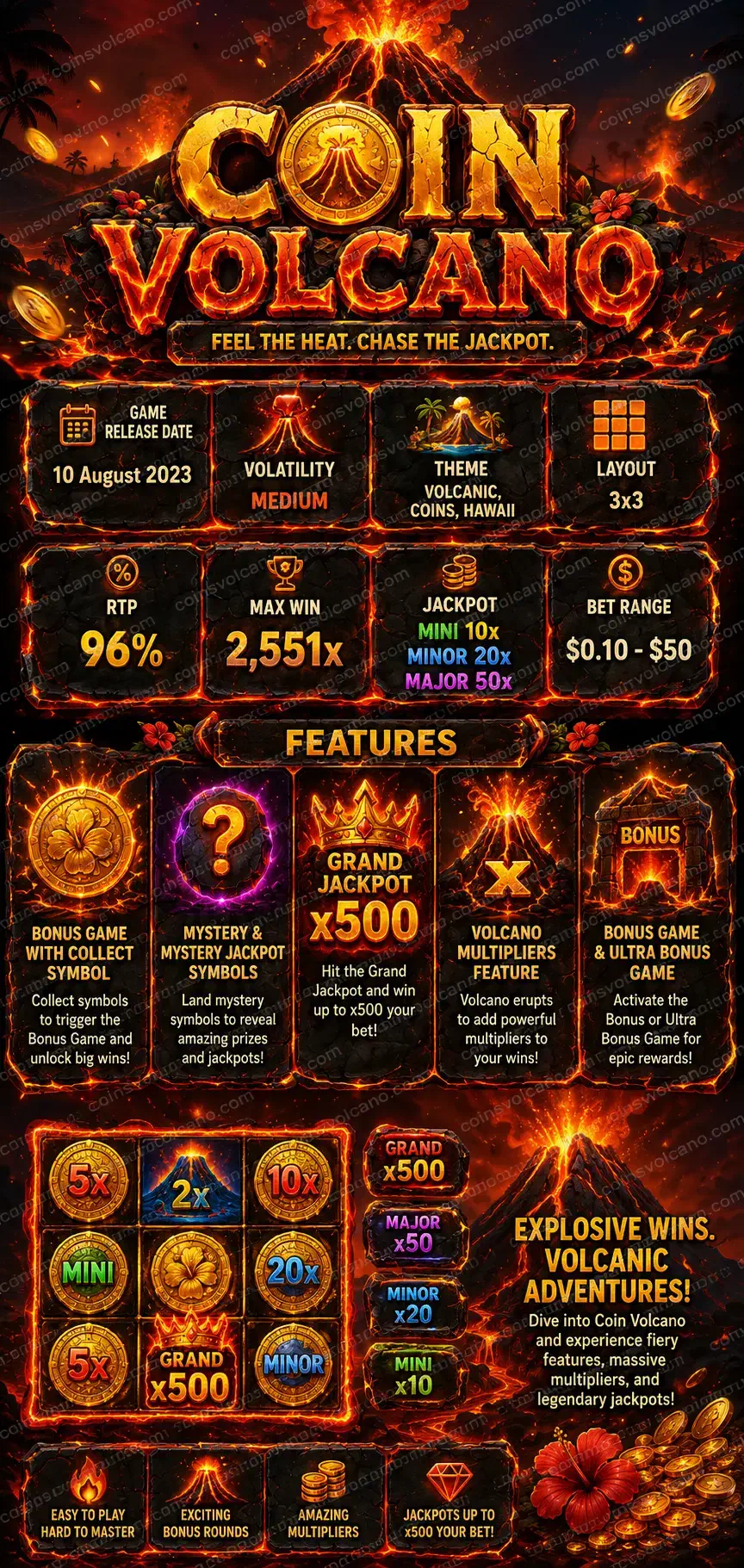
The published return is 95.66% / 96% (may vary by casino version). Subtract it from 100 and you get the number that matters to your bankroll: a house edge of 4.34% on the standard build, trimmed to 4.00% on the second certified build.
Put a stake on it. At $0.20 a spin, a thousand spins puts $200 through the game. The theoretical long-run cost of that $200 is about $8.68 on the standard build, or $8.00 on the alternative, a difference of 68 cents across a full evening of play. Both figures are averages drawn from millions of simulated rounds, not predictions about your thousand spins. Your actual result will be nowhere near either number, and that is the point of the next section.
Why your session ignores the average
The published return is a limit, not a schedule. Convergence toward it takes hundreds of thousands of spins; a thousand is statistically nothing, and even a very long human session sits far inside the noise. What you feel instead is volatility, rated here as Medium to medium-high, the shape of the distribution rather than its mean.
For this game there is a sharper point, and it applies to the whole Coin Volcano family. The base game pays nothing. There are no line wins, no scatter pays, no regular symbols at all: the reels carry blanks and coins, and every cent of the return is delivered inside the Hold and Win bonus. That makes the arithmetic brutal at the session scale: a hundred spins that never trigger the feature return zero, no matter how healthy the RTP looks on paper. The percentage is not describing a slow drip; it is describing the average of a lot of nothing and occasional something.
Check the paytable in your own lobby
Operators do not all install the same slot. 3 Oaks certifies multiple configurations and each casino licenses one, which is exactly why two figures circulate for this title in source tables, reviewers quote whichever build they happened to open. Neither is wrong; they describe different installations of the same game.
The only authority on your version is the in-game info panel. Open the paytable before you size a stake, and check the Grand jackpot value while you are there, since that also differs between builds. In a US-licensed lobby the state regulator’s certification is what fixes which configuration is running, the New Jersey Division of Gaming Enforcement, the Pennsylvania Gaming Control Board or your own state’s equivalent signs off on the build, and the operator cannot quietly swap it. On an offshore site nobody performs that function, and the number on the screen is the only assurance you get.
The full 3 Oaks volcano lineup
| Slot | Return to player | Cost per $100 wagered | Why it matters |
|---|---|---|---|
| Coin UP Volcano | see your casino's paytable | read from your panel | Newest release: expanding board and a per-line jackpot ladder |
| Coin Volcano (this page) | 95.66% | $4.34 | The family baseline, on the smallest board, every cent of it rides on reaching the bonus |
| Coin Volcano 2 | 95.66% | $4.34 | Identical cost for a busier bonus with multiplier cells and a far lower ceiling |
| 3 Coin Volcanoes | 95.67% | $4.33 | Three volcanoes stretch the bonus out without changing what a spin costs you |
| 3 Super Coin Volcanoes | 94-96% | $4.00-$6.00 | The only title where the operator’s choice of build moves your cost, check before playing |
| Jungle Volcano | 95.80% | $4.20 | Cheapest per unit staked, but the return hides in free spins, so the dry runs are longer |
| Lava Coins Hold and Win | 94.63% | $5.37 | The most expensive game in the lineup by a clear margin, and the only one with wilds |
| Lava Coins 2 | 95.50% | $4.50 | A collector mechanic rather than Hold and Win, priced just above the core series |
Read the middle column as a price list. It is the same information as the RTP column, stated in the units you deposit in.
- Coin Volcano fact sheet : symbols, jackpots and design
- Finding it at a casino , the state-first checklist
- Free demo : watch the distribution behave without paying for it
Nothing on this page is a prediction. Real-money play is 21+ and legal through licensed operators in eight states only; if it stops being entertainment, call or text 1-800-GAMBLER.