
Coin Volcano 2 RTP, from percentage to price
A return figure is a claim about a million spins you will never play. What makes it usable is the conversion, the percentage the casino keeps, the dollars that percentage costs at your stake, and whether the copy of the game in your lobby matches the spec being quoted. Coin Volcano 2 is a good test case, because it charges exactly what the original charges for a noticeably different game.
The math, in dollars
The published return is 95.66%. Flip it and you have the operator’s share: a house edge of 4.34%, which is the number that actually predicts what leaves your balance over time.
Now price it. A thousand spins at $0.20 stakes $200. Against a 4.34% edge, the theoretical long-run cost of that $200 is about $8.68. That figure is an average over an enormous sample, not a forecast: across any single thousand spins the realistic outcomes range from losing the whole $200 to finishing well ahead, and neither result says anything about whether the RTP is accurate.
Why your session ignores the average
Published returns converge only over hundreds of thousands of spins. A thousand is statistical noise; a hard evening of play is less than noise. What governs how those spins feel is volatility, rated Medium to high here, and the multiplier cells sharpen that curve further by moving value into the rounds where they land.
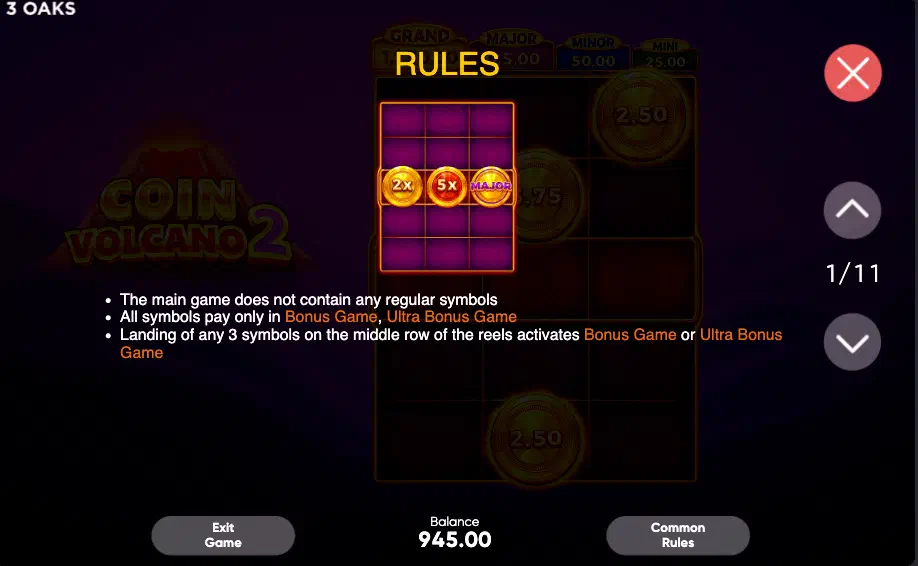
The decisive structural fact is the one the sequel inherits from the original: the base game pays nothing. Coin Volcano 2 has no regular pay symbols and no line wins outside the feature, so the entire published return is delivered inside the Hold and Win bonus. A session that never triggers it returns zero, not a reduced amount, zero, and no RTP figure, however healthy, changes that. When people say a high-RTP slot “felt tight”, this is usually the mechanism they are describing.
Check the paytable in your own lobby
The same slot ships in more than one certified configuration, and each operator installs the one it licensed. That is why review tables occasionally disagree with each other about a game whose name has not changed, they are quoting different builds, not making mistakes.
Your version is settled in one place, the in-game info panel. Open the paytable before you set a stake, read the return it states, and check the jackpot values alongside it. In a US-licensed lobby that build is fixed by the state regulator’s certification, Michigan’s Gaming Control Board, the Connecticut Department of Consumer Protection or whichever agency licenses the operator signs off on the configuration, and it cannot be swapped without going through them again. Offshore, nothing plays that role, and the paytable is simply a claim the site makes about itself.
The full 3 Oaks volcano lineup
| Slot | Return to player | Cost per $100 wagered | Why it matters |
|---|---|---|---|
| Coin UP Volcano | see your casino's paytable | read from your panel | Newest release: expanding board and a per-line jackpot ladder |
| Coin Volcano | 95.66% | $4.34 | The template, on a compact board, priced identically to its own sequel |
| Coin Volcano 2 (this page) | 95.66% | $4.34 | You pay the original’s price for multiplier cells, a wider grid and a lower ceiling |
| 3 Coin Volcanoes | 95.67% | $4.33 | Three volcano roles keep bonus rounds alive longer for effectively the same cost |
| 3 Super Coin Volcanoes | 94-96% | $4.00-$6.00 | Your cost depends on which build the casino licensed, which is unique in this group |
| Jungle Volcano | 95.80% | $4.20 | The lowest price here, paid for with genuine free spins and much longer dry runs |
| Lava Coins Hold and Win | 94.63% | $5.37 | Clearly the costliest title on the list, and the outlier the others should be judged against |
| Lava Coins 2 | 95.50% | $4.50 | A collector loop instead of Hold and Win, priced a step above the core series |
The middle column is the same information as the second, expressed in the currency you deposit in. It is the honest way to compare two slots you are choosing between.
- Coin Volcano 2 fact sheet : symbols, features and design
- Finding it at a casino : state legality before bonus offers
- Free demo , the cheapest way to see the variance for yourself
None of these figures predicts a result. Real-money play requires an operator licensed by one of the eight iGaming states and a player aged 21 or over; 1-800-GAMBLER is free, confidential and staffed around the clock.