
3 Coin Volcanoes RTP, the figure, converted
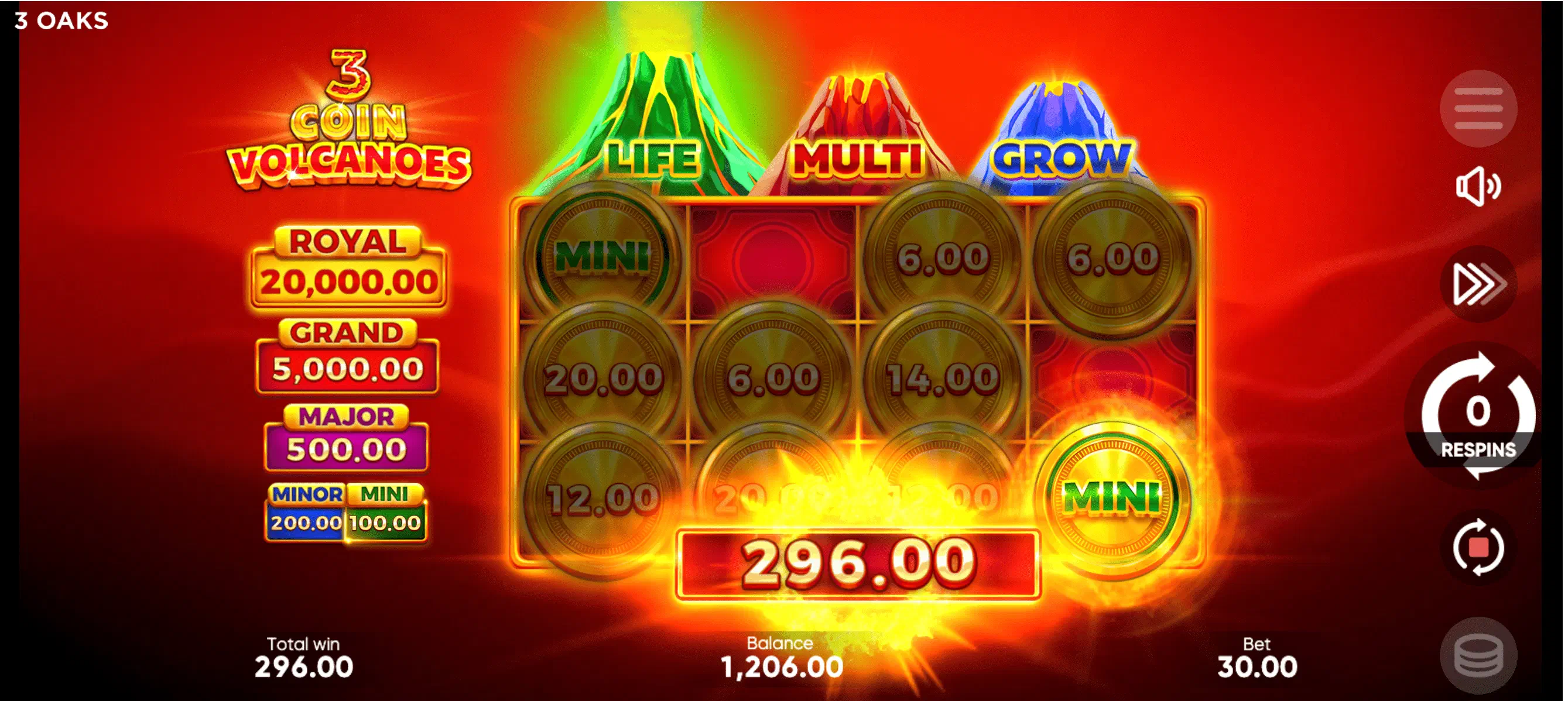
Three volcanoes, three jackpot tiers, one number that every review repeats without explaining. The return only becomes useful when it is turned around into a cost: what the house keeps, what that amounts to at a small stake, and whether the copy you are spinning is the one the figure describes.
The math, in dollars
The published return is 95.67% / 95.68% (may vary by casino version). Subtract from 100 and you have the house edge: 4.33% on the primary build. The alternative certified configuration comes in at 4.32%, a difference of one hundredth of a percentage point, which is a gap too small to act on and not worth switching casinos over.
Attach a stake and the abstraction disappears. At $0.20 a spin, a thousand spins puts $200 through the reels, and the theoretical long-run cost of that $200 is about $8.66. That is what the game charges on average for the entertainment, calculated across a sample far larger than any player will ever produce. It is not a prediction that you will be $8.66 down after a thousand spins; you will almost certainly be somewhere else entirely.
Why your session ignores the average
Return figures converge over hundreds of thousands of spins, and they converge slowly. A thousand spins is statistically nothing, the distance between your result and the published number after an evening of play says nothing about either. Volatility is what you actually experience, rated Medium to high here, and with three volcanoes lengthening bonus rounds the swings can be substantial in both directions.
The structural point matters more than the rating. Like every title in the Coin Volcano family, this game pays nothing in the base game. There are no regular symbols and no line wins; the reels hold blanks and coins, and the full published return is paid out inside the Hold and Win bonus. Eruption, Life and Grow all operate there and nowhere else. So a stretch of spins that never triggers the feature returns exactly zero, which is why the percentage can be perfectly accurate and your last hundred spins can still be a flat loss.
Check the paytable in your own lobby
Operators install different certified configurations of the same slot, which is the plain explanation for why comparison tables disagree with each other. Here the two builds are close enough that the practical advice is not “hunt for the better one” but “know which one you have”, because the same habit protects you on titles where the spread is much wider.
Open the in-game info panel before you commit a stake. It states the return for your version, the jackpot values, and the bet range the operator has set. That panel is the only source that describes your installation rather than a spec sheet somewhere. In a US-licensed lobby the build is fixed by the state regulator’s certification, Pennsylvania’s Gaming Control Board, the New Jersey Division of Gaming Enforcement or the equivalent agency wherever the operator holds its license, and changing it means going back through that process. Offshore, no such check exists.
The full 3 Oaks volcano lineup
| Slot | Return to player | Cost per $100 wagered | Why it matters |
|---|---|---|---|
| Coin UP Volcano | see your casino's paytable | read from your panel | Newest release: expanding board and a per-line jackpot ladder |
| Coin Volcano | 95.66% | $4.34 | The original and the cheapest way to learn the family’s collect-and-settle loop |
| Coin Volcano 2 | 95.66% | $4.34 | Multiplier cells and a wider board, at a price indistinguishable from the original’s |
| 3 Coin Volcanoes (this page) | 95.67% | $4.33 | Marginally the cheapest core title, and the one whose bonus rounds run longest |
| 3 Super Coin Volcanoes | 94-96% | $4.00-$6.00 | The direct sequel to this game, but with a cost your casino chooses rather than the studio |
| Jungle Volcano | 95.80% | $4.20 | A lower price bought with real free spins and the harshest droughts in the group |
| Lava Coins Hold and Win | 94.63% | $5.37 | The expensive end of the studio’s volcano work, and worth knowing before you open it |
| Lava Coins 2 | 95.50% | $4.50 | A collector mechanic priced between the core series and its costliest cousin |
Read the third column as a price tag. Two slots you cannot choose between on feel are usually easy to separate once you see what each charges for the same $100.
- 3 Coin Volcanoes fact sheet : symbols, volcanoes, jackpots
- Finding it at a casino , the checks that come before a deposit
- Free demo : watch the variance without funding it
Every figure here is a long-run average. Real-money play is limited to players 21 and over using operators licensed in the eight iGaming states; 1-800-GAMBLER answers calls and texts at any hour.