Coin Volcano 2 RTP, from a percentage to a dollar figure
A published return is a claim about millions of spins. What follows turns that claim into something you can weigh against the cost of an evening.
From return figure to house edge
Coin Volcano 2 publishes a return of 95.66%. Inverted, that is a house edge of 4.34%, the proportion of total turnover the game retains across the long run. Notice what it is not, the sequel widened the grid, added multiplier cells and layered on an Ultra Bonus, and none of that bought you a better price. It costs the same to sit at as the original.
Made concrete: a C$1 spin repeated 1,000 times means C$1,000 wagered, and the theoretical long-run cost of that turnover is about C$43.40. Read it as an average taken over a sample far larger than any human session, never as a prediction of where your particular thousand spins will finish. Real sessions cluster nowhere near the average.
The long run is longer than your evening
The published figure emerges over hundreds of thousands of spins. A thousand is not a small sample of that, it is statistically nothing, and drawing conclusions from it is like judging a climate from one afternoon. The thing that shapes a hundred spins is volatility, rated Medium to high here.
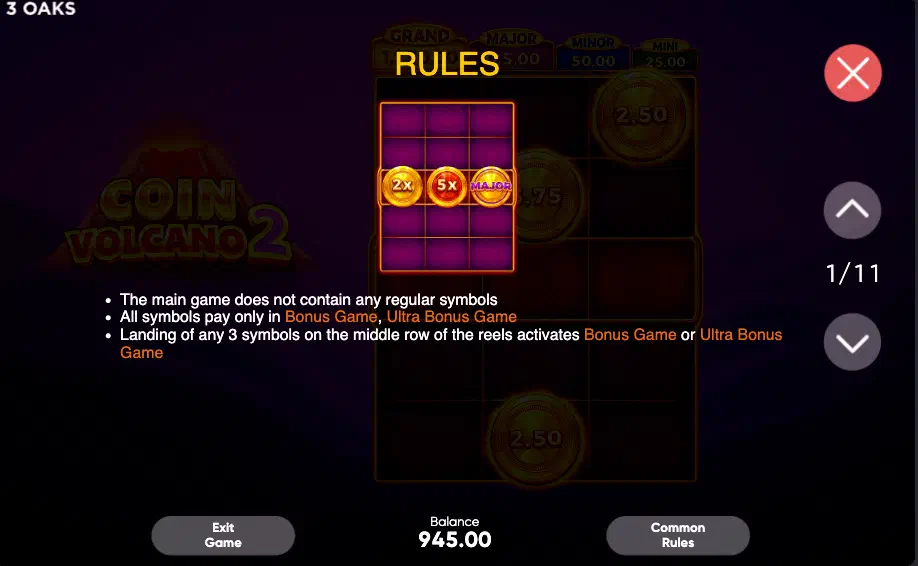
And there is a design fact that outranks both numbers. Like the rest of the Coin Volcano family, the sequel’s base game never pays: no line combination wins outside the feature, so the entire return is delivered inside the Hold and Win bonus. Fail to trigger it and the session returns nothing whatsoever, the RTP has no way to reach you. The multiplier cells make a triggered bonus swing harder in both directions, which sharpens the effect rather than softening it.
Two casinos, two builds, one game
Slots ship as certified configurations, and it is the operator that installs one. That means two Canadian lobbies can offer the same game under the same name with different long-run maths, and neither is doing anything improper. The in-game paytable or info panel is the only place that describes the build in front of you, so open it before you take any published figure, including this page’s, as applying to your account.
The Canadian layer adds a second variable. An open-market operator registered with AGCO and iGaming Ontario, or with AGLC in Alberta, is drawing from a wider third-party catalogue than a provincial lottery platform such as PlayNow or Espacejeux. Catalogue and build both differ, so the same title in two provinces is not a promise of the same mathematics.
All seven titles, ranked by edge
| Game | Edge over you | Published return | Practical consequence |
|---|---|---|---|
| Jungle Volcano | 4.20% | 95.80% | The best price on the shelf, delivered in the most punishing rhythm |
| 3 Coin Volcanoes | 4.33% | 95.67% | Two certified builds exist, separated by less than any player could notice |
| Coin UP Volcano | see your casino's paytable | read from your panel | Newest release: expanding board and a per-line jackpot ladder |
| Coin Volcano | 4.34% | 95.66% | The stronger of its two builds is worth hunting for, unlike its position here |
| Coin Volcano 2 (this page) | 4.34% | 95.66% | You get the extra features for free, so choose it on preference alone |
| 3 Super Coin Volcanoes | 4% to 6% | 94-96% | The lobby you pick decides the maths, which is true of nothing else here |
| Lava Coins 2 | 4.50% | 95.50% | Outside the volcano core mechanically, and priced slightly above it |
| Lava Coins Hold and Win | 5.37% | 94.63% | The costliest of the seven to keep returning to; treat it as an occasional detour |
3 Super Coin Volcanoes resists a clean placement on this ladder, because where it lands is decided by the operator rather than by the studio.
Keep reading
- Coin Volcano 2 slot , the full specification
- Casino checklist : checking the operator and the version
- Free demo : test the variance at no cost
A return figure is not a plan, and no bet pattern moves it. Set a budget before you open the lobby and play through your province’s regulated route, 19 and over in most of Canada, 18 and over in Quebec, Alberta and Manitoba.